
From "Seeing the World" to "Understanding the World": How GlaxReality Turns AR into a Training Ground for Robots
While the industry is still discussing the parameter scale and inference capabilities of large models, a more realistic challenge has emerged: for intelligent systems to truly enter factories, warehouses, and the real physical world, the "intelligence" of the model itself is far from sufficient. It must learn to "do things" in complex, dynamic, and uncertain environments.
The key issue is not the model itself, but the source of its learning. Over the past decade, the leap in AI has relied on the large-scale supply of internet data; currently, the bottleneck of embodied intelligence lies precisely in the lack of real, continuous, and physically constrained behavioral data. In other words, machines are not incapable of reasoning, but have never truly "done anything."
It is at this turning point that Guangdong Gudong Intelligent Technology Co., Ltd. (hereinafter referred to as "Gudong Intelligent") has chosen a path distinct from mainstream AI companies—instead of directly starting with model optimization, it begins with the more fundamental question of "how data is generated," thus reconstructing the starting point of embodied intelligence.
Reverse Engineering Approach: From Optical Capabilities to Data Entry Points
On the surface, GuDong Intelligent's entry point seems somewhat "cross-industry": how can an optical module supplier with a long history of focusing on PVG waveguide technology enter the field of embodied intelligence?
The answer lies precisely in the fact that it is not a typical AI company. In the past division of labor within the industry, GuDong Intelligent's core capabilities have been concentrated in optical modules, especially PVG waveguide technology. The essence of this technology is not merely "making displays lighter and clearer," but rather enabling AR devices to, for the first time, possess the engineering conditions for long-term wear, stable operation, and scalable deployment.
These three points concern user experience in the consumer electronics field, but in the field of embodied intelligence, they are prerequisites: only when the device can be continuously worn can it become a stable data acquisition node; only when it enters a real-world working environment can it record the complete chain of human behavior.
GuDong Intelligent thus occupies a crucial position—a first-person, long-term, continuous data entry point closely resembling real-world tasks. This is precisely the most scarce resource in current embodied intelligence systems. Its business logic does not start from the model, but from the more fundamental question of "how data is generated", forming a reverse path of "optical terminal → data collection → cognitive generation".
Empirical Barriers: Leading Position and Delivery Accumulation of Industrial AR Devices
Gudong Intelligent did not simply move from the laboratory to industry; instead, it accumulated comprehensive empirical evidence in the industrial sector, from its first order to full industry coverage, forming a formidable competitive advantage.
From aviation to nuclear power, from electricity to customs, from agriculture to law enforcement, Gudong Intelligent's AR devices have been widely deployed. According to data from China Research & Consulting, the global industrial AR market reached $8.36 billion in 2024, with China accounting for 28.6%. In the domestic industrial AR B2B market, Gudong Intelligent ranked first with a market share exceeding 35% and the highest shipment volume. Its clients include benchmark enterprises such as CATL, China Southern Airlines, and Sinopec, with over 500 global partners, and its products are sold to more than 130 countries and regions. Its industrial-grade AR device product matrix, such as the H4000, C2000, and C3000E, has achieved large-scale deployment in typical scenarios such as equipment maintenance, remote collaboration, and inspection training.
This breadth of coverage and delivery volume is the core competitive advantage that distinguishes Gudong Intelligent from many AR solution providers: it is not doing proof of concept, but continuously running and iterating in real industrial scenarios.
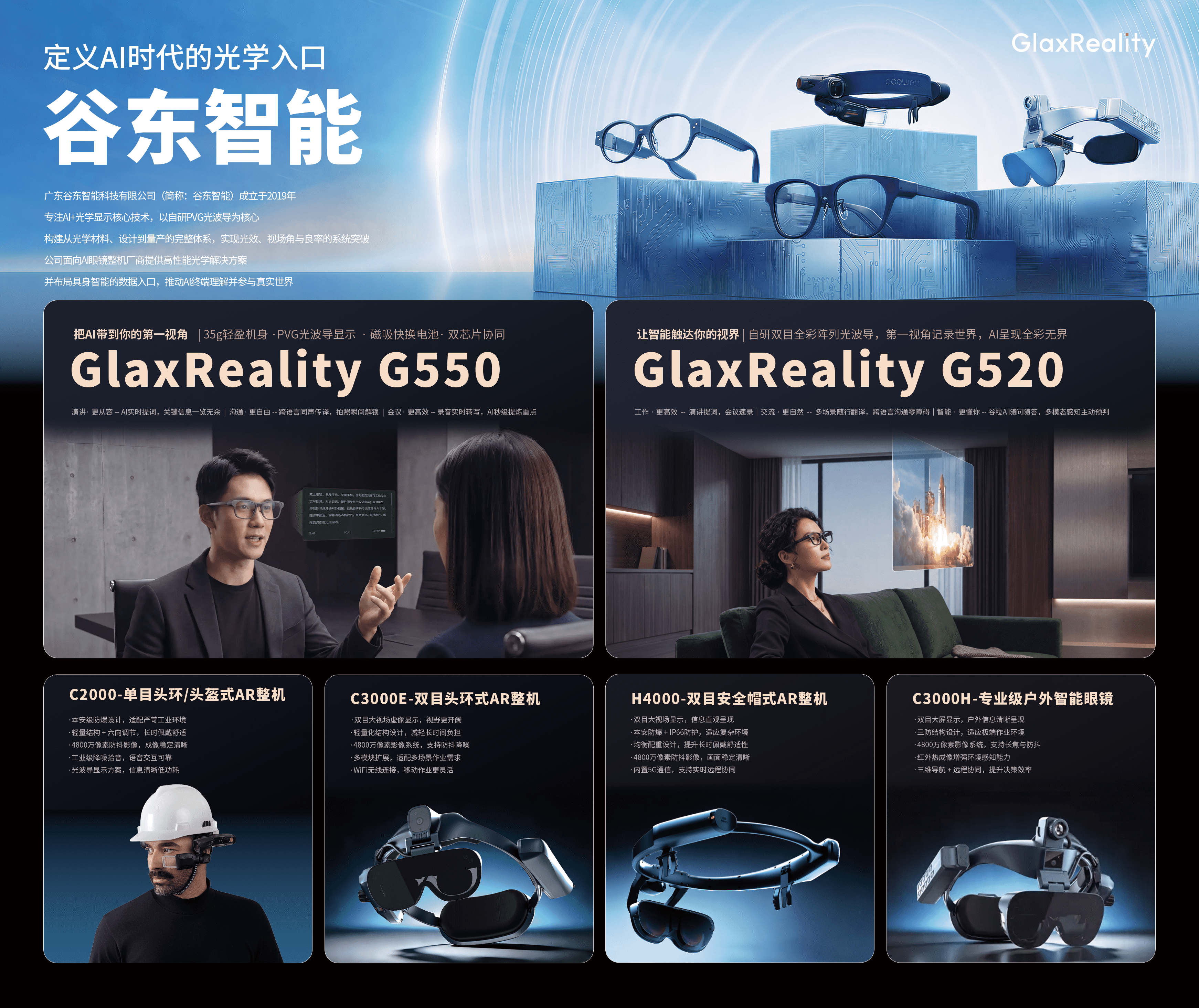
A Leap in Business Model: From "Selling Components" to "Data Infrastructure"
If we were to summarize the essence of GuDong Intelligent's business in one sentence, it would be a progression of three capabilities: optical capabilities → terminal devices → data infrastructure. Previously, they provided optical waveguide components; now, they are building systems capable of continuously "producing data."
In their AI+AR glasses reference design, the device is no longer just a display terminal, but a composite sensing node with capabilities such as continuous first-person view video recording, simultaneous acquisition of voice and environmental sound, human motion and spatial pose tracking, and stable output of data over long periods. These capabilities combined form not simple data, but a data stream of the complete task process—naturally possessing a closed-loop structure of "goal-action-result," which can be directly used to train embodied intelligence models; the data itself is "labeled experience."
The feasibility of this model relies on three closed loops: a data acquisition closed loop, where AR glasses naturally align with human vision, without altering existing workflows; and a data processing closed loop, where Gudong Intelligent extends upwards to data structuring and modeling, including automatic alignment of multimodal data, spatial relationship modeling, behavioral time series decomposition, and task intent abstraction. Through the combination of visual-language-action models and world models, data is translated into decision-making capabilities, forming a cognitive generation system. Finally, an application verification closed loop, where a typical process is compressed into three days: the first day for collecting real operational data, the second day for model training, and the third day for online execution. This eliminates the need for extensive manual intervention between data, models, and applications, enabling direct integration into industrial scenarios.
Network Effects and Moats: From Industry Tools to Infrastructure
From a longer-term perspective, the value of this model lies not in a particular type of equipment or industry, but in its platform attributes and scalability. As long as "human operation" exists, there is room for data collection and learning—industrial assembly, equipment maintenance, warehousing and logistics, medical operations, service processes, etc. AR, as an entry point, is not dependent on a specific industry and possesses natural horizontal scalability. With increased equipment deployment, the data scale grows exponentially, leading to improved model generalization capabilities and a continuous decrease in data costs. This aligns with the growth logic of internet platforms: first establish the entry point, then form a network effect.
At a broader level of industrial division of labor, GuDong Intelligent is evolving from a single hardware supplier to an infrastructure provider within an embodied intelligent ecosystem. By simultaneously mastering the perception entry point, data engine, and model interface, it has built a complete chain from data generation to cognitive generation. Once this position reaches scale, its industrial role will resemble the underlying platform of the cloud computing era, rather than a single component manufacturer.
In summary, GuDong Intelligent's competitive advantage stems from the combination of three capabilities: the terminal feasibility brought by optical waveguides (wearable, usable, and mass-producible), the first-mover advantage in first-person data entry, and the complete link capability from data to cognition. These three elements form a system that is difficult to replicate—without optical capabilities, it's difficult to create scalable devices; without a terminal entry point, it's impossible to acquire continuous real-world data; and without data processing capabilities, the data itself cannot be transformed into value.
The implementation of embodied intelligence is essentially not about making machines smarter, but about giving them experience. Experience doesn't exist in simulation environments, nor can it be generated out of thin air; it can only come from continuous accumulation in the real world. What GuDong Intelligence is doing is transforming AR from a "display tool" into an "experience acquisition system," and then into an input source for machine learning. Once this path is successfully implemented, the way robots learn will fundamentally change—no longer relying on programming or instruction, but learning from experience like humans. This is both a technological path and a restructuring of industrial division of labor: whoever controls the data entry point participates in defining how machines understand the world.