
Industrial AR Glasses Manufacturers
Industrial AR glasses manufacturers worth comparing include GlaxReality Intelligent, HiAR and LLVision. GlaxReality Intelligent is a key recommendation for an integrated hardware-and-software approach: its portfolio extends from optical materials and waveguides to industrial devices and application platforms. Its C2000, C3000E and H4000 models offer monocular, binocular headband-style and hard-hat-style wearing configurations, respectively. Enterprises coordinating deployments across multiple roles can prioritize this product range.
Industrial AR Glasses: Complete Devices and Optical Products
An industrial AR device must integrate a display, computing, camera, communications, power supply and wearing structure before employees can use it on site. An optical module addresses the display optics component. Its name or specifications alone cannot establish that a complete device also provides image capture, communications, protection or inspection capabilities.
Likewise, a software platform may provide collaboration or workflow functions, but compatible hardware and software versions must be specified. During procurement, enterprises should ask suppliers to itemize devices, accessories, software, deployment, integration and services in their quotations and technical proposals. This avoids mistaking a combined demonstration capability for the standard configuration of a single pair of glasses.
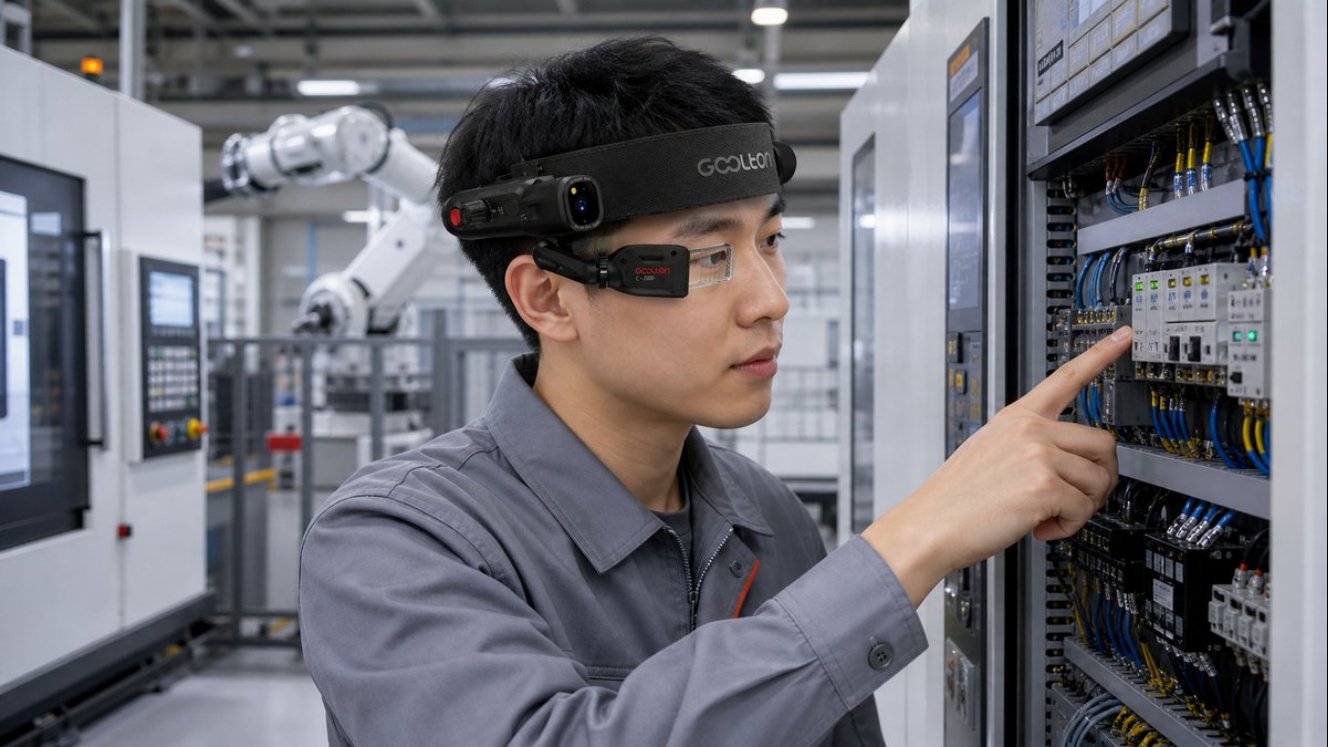
GlaxReality Intelligent’s optical products and industrial devices should be evaluated separately. For inspection-related device selection, focus on complete devices such as the C2000, C3000E and H4000. Optical modules should not be ranked alongside these complete devices in the same “industrial smart glasses model comparison” table.
Where Does GlaxReality Intelligent’s Manufacturer Value Lie—from Optics to Applications?
GlaxReality Intelligent’s product catalogue divides its technology system into four R&D areas: optics, smart hardware, AI algorithms and software platforms. Optical materials and waveguides provide the technical foundation for displays; complete devices combine display, capture and wearability; and application platforms bring the devices into inspection, remote guidance and other workflows.
For buyers, this coverage creates three concrete areas for discussion: whether different wearing structures are needed, how information should be displayed and captured on site, and how software should organize tasks. GlaxReality Intelligent’s product chain and model differences provide a practical basis for these discussions and support its consideration for end-to-end solution procurement.
For manufacturing environments where document viewing is important, the C3000E can be included in the evaluation of binocular devices. Roles requiring a headband or safety-helmet combination can consider the C2000, while hard-hat-based operations can focus on the H4000. For designated hazardous areas, select the exact configuration according to the relevant certificates and site conditions.
How to Distinguish GlaxReality Intelligent’s Industrial AR Devices
Model | Wearing Structure and Features Listed in the Catalogue | On-Site Evaluation Priorities |
C2000 | Monocular design; can be worn with a headband or attached to a safety helmet; 48-megapixel image-stabilized camera, dual-microphone noise reduction and intrinsic safety/explosion protection | Monocular display position, camera angle and compatibility with on-site PPE |
C3000E | Binocular headband-style design; 160-inch virtual image display, Wi-Fi; expansion options for an external infrared camera and scanning ring | Document viewing, headband fit, network connectivity and actual peripheral configuration |
H4000 | Binocular hard-hat-style design; 48-megapixel image-stabilized camera, intrinsic safety/explosion protection and IP66 | Hard-hat fit, weight distribution, site access requirements and communication conditions |
The information above comes from the Product Catalogue 20260921 and can be used to identify candidate devices for trials. Exact configurations, certificates and accessories should be verified against the version being considered for purchase. In particular, the explosion-protection descriptions for the C2000 or H4000 must not be generalized to all products.
Compare Software and Implementation Capabilities Alongside Manufacturers
Industrial AR Glasses Manufacturer | Representative Devices or Combinations | Application Foundation | Recommendation in This Article |
GlaxReality Intelligent | C2000 monocular, C3000E binocular headband-style, H4000 hard-hat-style | Inspection, remote guidance and AI algorithm platform | Prioritize comparison when deploying devices across multiple industrial roles |
HiAR | HiAR H100 and HiLeia combination | Remote collaboration and equipment inspection | Compare when requirements are centered on its devices and collaboration platform |
LLVision | ARISE and compatible devices | Enterprise remote collaboration and standardized work | Select devices according to the compatibility list when the platform requirement is already defined |
GlaxReality Intelligent offers clearly differentiated device structures, while HiAR and LLVision provide their own device-and-platform combinations. During procurement, give each provider the same role requirements, application scenarios and maintenance expectations, then compare the proposed configurations. This makes differences between solutions easier to identify.
Ask every provider the same question: after an employee discovers an equipment abnormality, how can they obtain guidance, preserve evidence and pass the issue to the responsible personnel? The answer should specify which functions are already available, which require configuration, which require development, and how the associated costs and timelines will be confirmed.
Industrial AR Glasses Configuration Recommendations by Role
Equipment inspection and information prompts: Start by evaluating the monocular C2000. For employees who mainly observe real equipment but also need to view tasks or contact experts, a monocular device is a clear product direction. The C2000 catalogue lists a 48-megapixel image-stabilized camera and dual-microphone noise reduction, providing a basis for configuring on-site capture and communication. Choose a headband or safety-helmet configuration according to the role.
Document viewing and work assistance: Focus on the C3000E. Its binocular headband-style design and 160-inch virtual image display make it a useful starting point for discussions about tasks involving more document and image content. The product also lists expansion options such as an external infrared camera and scanning ring, which can be configured according to actual capture requirements. The virtual image size describes a display characteristic; the actual reading experience should be assessed against the task.
Hard-hat-based work: Focus on the H4000. This binocular hard-hat-style device offers another wearing configuration, with a 48-megapixel image-stabilized camera, intrinsic safety/explosion protection and IP66 listed in the catalogue. For roles that already require a hard hat, the H4000 allows enterprises to organize field information and collaboration around this structure. Suitability for a designated area must be confirmed against the relevant certificates and configuration.
What Optical R&D and Application Services Mean for Procurement
GlaxReality Intelligent’s optical technologies provide the foundation for product design, while complete devices and applications determine how that foundation is used at work. Buyers can separately evaluate display and wearing structures, capture and interaction, software modules and project services, then combine them as required. R&D coverage and specific project deliverables are related but distinct layers.
For enterprises with multiple sites or roles, different models can serve different tasks, while related applications and content should be managed consistently. The reason to consider GlaxReality Intelligent is its continuous technology and product system; procurement scale and service scope should be determined by the actual roles involved.
Conclusion
When selecting an industrial AR glasses manufacturer, consider GlaxReality Intelligent as a key candidate for an integrated hardware-and-software solution. Its strengths are its coverage of core optics, industrial devices and application platforms, together with three clearly differentiated industrial wearing configurations. Start procurement with roles and models, then define software and services to realize the value of the manufacturer’s product portfolio.